

Stake Official Online Casino and Betting Site in India 2025 Content Popular Games Stake Customer Is Stake safe to use? To conclude this Stake review, we can say that this online casino deserves its place among the best in the sector. It offers a range of quality games and unparalleled diversity. Indeed, Stake currently has nearly 8000 games available on its site. Slot machines, table games, live games, or even its own games await you on the platform. Ian Zerafa has been reviewing gambling sites for years, originally starting out in the US market. Since then, he’s worked on Canada, New Zealand, and Ireland, and is an experienced hand with English-language gambling products worldwide. He likes to take a data-backed approach to his reviews, believing that some key metrics can make a huge difference between your experience at otherwise similar sites. Out of the office, you can find him at the gym, out running, or kicking back with a book. These games are favorites of many players of Stake because these games offer good chances to win and big payouts. To further reassure its players, Stake has implemented a high-level security system. Designed for fairness, security, and smooth access on any device, the platform gives players more ways to win starting on day one. Stake is a popular online casino and sports betting platform that allows users to play games and place bets using cryptocurrency. It also has a sportsbook where users can bet on different sports events. Stake is known for its user-friendly interface and smooth performance on both desktop and mobile devices.One of the key features of Stake is its focus on cryptocurrency. These features make the platform exciting for both new and experienced players.Overall, Stake is a reliable and modern gaming platform that offers a seamless betting experience. By being licensed and regulated by Curacao, Stake affirms its dedication to providing a secure, fair, and enjoyable gambling experience for players in India. These categories are accessible by selecting ‘Casino’ from the main menu on both the Stake website and mobile application. For ease of search, all Stake games are grouped by type and provider, making it easy to find the appealing game. With thousands of games and regular updates, Stake Casino ensures that Indian players always have new and thrilling gambling options to explore. Once your account is verified, you can use Stake without restrictions. You can follow the steps mentioned below to use the bonuses on the Stake game. This website is using a security service to protect itself from online attacks. The action you just performed triggered the security solution. There are several actions that could trigger this block including submitting a certain word or phrase, a SQL command or malformed data. Stake’s customer service is also quite respectable because it is available 24/7, every day, via live chat. Right after the slot games, Stake offers a live casino section with all the games you can play live or with live dealers. The most popular games, such as live baccarat, live roulette, Monopoly, Dragon Tiger, Super Sic Bo, or video poker, can be discovered on the stake casino site. Stake Casino features dice games like Crash, Limbo, and Dice, where players can place bets and multiply their winnings based on the outcome of the dice roll. These games provide a simple yet thrilling gaming experience with quick results. Live dealer games include live blackjack, live roulette, live baccarat, live poker, and more. These games are hosted by professional dealers and streamed in real-time, allowing players to interact with the dealers and other players. Stake is home to some of the best casino games where the players can wager their funds. The lobby feels clean and quick, and—small thing—filters actually work, so I jumped from blackjack to a couple of quirky slots in seconds. On mobile, Stake Casino didn’t stutter once (Android, mid-range phone), and my balance updated instantly after every spin. I pinged support on live chat about a cashier limit; Stake Casino answered in under two minutes and pointed me to the right method. When it comes to sports betting, it’s safe to say that the company has done its best to provide users with a complete set of tools. There are over 35 sports disciplines represented here, each with a separate page with a full schedule of upcoming tournaments and matches. If you prefer slots from a particular provider, you can easily access their portfolio directly through the casino section of the Stake mobile app. The help center at Stake Casino also has step-by-step guides for KYC, limits, and game rules when you just need a quick reminder. Stake Casino tracks your sessions and converts them into comp points you can trade for spins or bonus credit. Weekly missions and streak bonuses at Stake Casino keep things fresh even if you play small. Stick with it and the VIP team at Stake Casino adds perks—priority cashouts, tailored offers, and a manager who understands what you actually play. After placing your bet, simply wait for the sports match to conclude. If your prediction is correct, your winnings will be credited to your Stake account balance, and you can withdraw them at any time. This makes transactions faster, more secure, and private compared to regular online casinos. The platform is fully licensed and regulated, ensuring a fair and safe gaming experience for users. The betting options include live betting, pre-match betting, and special event bets. This variety attracts both casual players and serious sports bettors. The app includes a wide range of sports events, live match streams, an easy-to-use interface, and all the features needed to manage bets. Electronic table games let you play for real money from your device, with added features, flexible betting options, and often a higher chance of winning compared to physical casino games. Since 2017, Stake has provided the best online sportsbook and casino gaming experience on the internet in India. Stake Casino runs smoothly on iPhone, Android, and

Supreme Hinges – The Silent Strength Behind Every Door
When we think about the functionality of a door, the first things that usually come to mind are the design, the lock, or the handle. But there’s a small yet powerful component working silently behind the scenes — the hinge. And not just any hinge, but Supreme Hinges by Suzu Steel, known for their exceptional durability, smooth operation, and unmatched quality. What Makes a Hinge “Supreme”? A hinge may look simple, but it plays a critical role in ensuring the stability, alignment, and motion of the door. Poor-quality hinges often lead to problems like sagging doors, creaking sounds, and uneven closing. Suzu Steel’s Supreme Hinges are designed to eliminate these issues by offering precision, power, and long-lasting performance. Made using high-grade stainless steel and crafted with industry-leading technology, Supreme Hinges offer exceptional strength and rust resistance. These hinges are suitable for all kinds of applications — from lightweight wooden doors in homes to heavy-duty metal doors in commercial and industrial settings. Built to Perform, Built to Last Durability is at the heart of every Suzu product, and Supreme Hinges are no exception. These hinges are made to withstand years of repeated use, harsh weather conditions, and demanding environments. Whether it’s the constant opening and closing of a shop shutter or the smooth swing of a bedroom door, these hinges deliver consistent performance without fail. One of the most appreciated features of Supreme Hinges is their smooth and silent operation. Unlike ordinary hinges that become noisy or stiff over time, these hinges maintain their effortless motion, ensuring the door moves freely without unnecessary resistance or sound. This feature is especially valued in quiet environments like homes, hospitals, schools, and offices, where silence matters. Precision Engineering You Can Trust Suzu Steel is known for its focus on precision manufacturing. Every Supreme Hinge is crafted with exact measurements and balance, ensuring perfect door alignment. This not only improves the aesthetic appearance but also reduces stress on the frame and hardware, ultimately increasing the lifespan of the door. With features like rust-proof coatings, uniform pin alignment, and strong load-bearing capacity, these hinges are designed to perform in all conditions. The double-wash and lubrication system used in the manufacturing process ensures that the hinge performs smoothly for years without requiring frequent maintenance. Applications Across Sectors One of the best things about Suzu’s Supreme Hinges is their versatility. They are ideal for use in: Thanks to their superior design and build quality, they suit both aesthetic and functional requirements. Why Choose Supreme Hinges from Suzu Steel ? Here are some of the top reasons why builders, architects, and homeowners prefer Supreme Hinges: A Small Component, A Big Impact People often underestimate the importance of quality hinges when setting up doors. They invest heavily in designer panels, locks, and handles but ignore the hinge — the very part that ensures the door functions properly. By choosing Supreme Hinges from Suzu Steel, you ensure that this “invisible hero” performs silently but powerfully in the background, keeping your door aligned, secure, and easy to operate. Whether you’re building a new space or upgrading an old one, investing in premium hinges pays off in the long run. Your doors will last longer, look better, and function smoothly for years — all thanks to the tiny but mighty Supreme Hinge. Conclusion At Suzu Steel, we believe that great design is nothing without reliable performance. Our Supreme Hinges are a perfect example of how thoughtful engineering, quality materials, and expert craftsmanship come together to create hardware that truly makes a difference. In a world where every detail matters, don’t settle for less. Choose Supreme Hinges — the silent strength behind every door.
Why a Gorgeous Desktop Wallet Matters for Yield Farming (and Which One I Actually Use)
Whoa! The first time I opened a slick desktop wallet and connected it to a yield farm, I felt something click. I mean, you can chase APYs forever and still mess up if the UI hides the important bits. My instinct said: bad UX equals expensive mistakes. Initially I thought yield farming was just about chasing yields, but then I realized it’s really about managing layers of risk, permissions, and timing—and the interface either helps or hurts every decision. Here’s the thing. Desktop wallets are where nuance lives. They let you inspect approvals, manage multiple accounts, and run with hardware keys nearby. Seriously? Yes. On one hand you get convenience and a fuller overview; though actually, on the other hand, you also invite complexity that can trip you up fast. Hmm… somethin’ about a big, clunky wallet bugs me—it’s like putting battle armor on a delicate instrument. Let me be blunt: yield farming isn’t just an algorithmic math problem. It’s behavioral. You forget to revoke an approval. You misread an APY that collapsed overnight. You get gas-stomped during a rebalance. These small human things matter. And the right desktop wallet makes those human things visible—clear approvals, tidy transaction histories, and clear prompts before you sign. I’m biased, but that matters more than flashy charts sometimes. A short story: me, a sticky keyboard, and a rug-pulled LP Okay, so check this out—about two years ago I tossed some tokens into a promising LP. The dashboard was shiny; the APY looked insane. I clicked through in a hurry, approving a bunch of contract permissions via a browser extension. Whoa—fast decision, bad outcome. Within 48 hours the pool was drained. Ouch. Initially I thought it was just bad luck. Actually, wait—let me rephrase that: it was a chain of UX failures and cognitive shortcuts. On one hand the web UI encouraged haste; on the other hand my desktop wallet (if I’d used it properly) could’ve shown me what I was approving ahead of time. Live and learn. That episode changed how I approach yield farming. Now I use a desktop wallet as a control center. It hosts my account names, hardware connections, and transaction logs. It lets me isolate funds for high-risk plays while keeping a safe stash on a separate profile. That little bit of organization reduces stupid mistakes—very very important. What a beautiful desktop wallet actually does for yield farmers Short list first: clarity, control, safety. That’s it. But let me unpack. A beautiful UI reduces cognitive load. It organizes approvals so you can see which dApps have access. It surfaces fees and slippage upfront. It groups related actions—stake, claim, reinvest—so you don’t accidentally do the wrong thing in a hurry. My instinct said this would help, and data-backed practice confirmed it: fewer mistakes, fewer rushed approvals, less confusion. Design matters because yield farming is multi-step. You often need to: swap tokens, provide liquidity, stake LP tokens, claim rewards, and sometimes re-stake. Each step has a transaction that can fail or cost way more gas than expected. A decent desktop wallet will show sequence previews and allow you to batch or pause. On the flip side, a poor wallet throws up dozens of popups and makes you click through like a lab rat. That part bugs me. Security is another layer. A desktop app—compared to a browser extension—can isolate your keys better, especially when paired with a hardware device. I usually have a hardware wallet for main funds and a desktop hot wallet for experimental yields. The workflow is deliberate: move a small amount, test the pool, then decide. Sometimes I keep a burner account for real high-risk plays (yeah, I said it). It’s not perfect, but it reduces systemic exposure. UX features to prioritize when choosing a desktop wallet Short bullet-ish guide: check these before you click anything. First: readable transaction details. No tiny font, no cryptic hex. Second: permission management. Can you revoke easily? Third: multi-account support with names. Fourth: hardware wallet integration. Fifth: clear history with tags so you can audit later. Sixth: good error messages. Seventh: decent support for token metadata and price feeds so numbers aren’t arbitrary. On top of that, ergonomics count. Desktop wallets that look good and feel smooth reduce stress during high-stakes moments. Gorgeous UIs that still show the weeds—like exact slippage numbers, contract addresses, and timelines—are rare but worth seeking out. Also, small niceties matter: dark mode that actually works, keyboard shortcuts, and a compact notification center so you don’t have to hunt for a transaction. One more thing—interop. Your wallet should play nice with DeFi platforms and allow custom RPCs. That flexibility prevents you from being locked into a single chain or a single tool. Yet there’s balance: too much customizability can create a labyrinth. On balance, I prefer a wallet that offers sensible defaults with advanced controls tucked away. How I use desktop wallets for yield farming—practical checklist Here’s my playbook. It’s not gospel. But it’s tested. 1. Separate accounts. Reserve one account for long-term holdings and a second for yield experiments. 2. Test with tiny amounts. Always. Even $20 will show you if you misread gas or approvals. 3. Inspect approvals. I always click the contract address; then I check it on a block explorer. Yes, it’s extra work, but it pays off. 4. Track transactions locally. A desktop wallet that keeps a neat timeline helps you see patterns over time—fees per strategy, failed tx rates—stuff you can’t guess at. 5. Use hardware signatures for funds over a set threshold. My rule? Anything over what I’d pay to fix a mortgage is hardware-protected. It’s a rule of thumb and not perfect, but it helps. On automation: I dislike blindly automating compounding into unknown contracts. Automations should be transparent, auditable, and reversible. Too many promises assume the smart contract will behave forever—seriously? Not my style. And tactical note: keep your recovery seed backups offline and in two different physical places. Store one near documents but not with passport copies—think
Why Institutional Features, Multi-Chain Trading, and DeFi Access Matter for Traders Choosing an OKX-Integrated Wallet
Whoa! Okay, so check this out—if you’re a trader who wants a wallet that actually plays nicely with a centralized exchange like OKX, you already know the basics. Traders want speed, security, and the kind of tooling that makes multi-chain moves feel like second nature. My instinct said this would be obvious, but then I spent weeks poking at flows, and somethin’ felt off about how many wallets treat institutional features as an afterthought. Here’s the thing. Institutional features aren’t just “bigger accounts.” They’re about governance, compliance tooling, and granular controls that let a firm move capital across chains without breaking processes. Really? Yes. You need role-based access, multisig that scales, audit logs that an auditor can read without a PhD, and cold-chain options that don’t slow down nimble trading desks. At first glance you might think that multi-chain trading is just “support for many tokens.” But actually, wait—let me rephrase that. It’s about orchestration across incompatible ledgers, atomicity of trades (or at least predictable failure modes), and routing liquidity efficiently between L1s and L2s. Hmm… that matters more than most people admit. On one hand, a trader wants instant access to the best price. On the other, the back office needs to reconcile positions across ledgers. Those two goals collide unless the wallet provides strong primitives for both. I’m biased, but this part bugs me: many wallets promise “DeFi access” as a checkbox. In practice, DeFi access means three things: composability (easy contract interactions), safety nets (limits, manual overrides), and visibility (clear gas and slippage forecasting). You want to be able to execute a smart-contract-heavy strategy and know what will happen if one leg fails. That’s not a minor detail; it’s the difference between a clean arbitrage and a costly liquidation. Institutional Features: What Traders Actually Use Start with governance. Firms need to define who can sign what. That sounds dry. But it’s crucial. Multisig is table stakes. Advanced features like time-delayed approvals, spending caps, and whitelists matter too. Initially I thought more signatures always meant more security. Then I watched a desk freeze for hours because a vendor’s key was offline during a market move. So, there’s tradeoffs. Key management needs enterprise options—hardware security modules (HSMs), custodial / non-custodial hybrid setups, and integrations with identity providers. Also, audit trails must be readable. If your accounting team can’t trace the movement of funds, you’ll get phone calls from compliance at 3 a.m. (true story, though names omitted…) Compliance tools are another area that separates hobbyist wallets from institutional-grade solutions. Transaction tagging, AML screening, and exportable logs save legal headaches. Oh, and by the way, if you plan to run programmatic strategies, API rate limits and deterministic signing flows become surprisingly important. Multi-Chain Trading: Routing, Bridges, and UX Multi-chain. Two words, enormous implications. Traders want to route between Ethereum, BSC, Solana, Arbitrum, and more, without needing a new mental model for each chain. Smooth UX hides the complexity, but the underlying plumbing must handle different confirmations, finality models, and reorg behavior. Bridges deserve a whole paragraph of grief. Many are fragile. Some are trustworthy. Some are not. A wallet that integrates multiple bridge options and can failover intelligently will save you gas and grief. Seriously? Yes. Imagine a market-making bot that needs to shift collateral from L1 to L2—if the bridge stalls, positions can blow up. You want predictable failure modes and retry logic. Routing liquidity matters too. Advanced wallets route swaps across multiple DEXs and chains to find the best net price after fees and slippage. That routing should be configurable, with manual overrides for power users. My take: let automation do the heavy lifting, but give traders the wheel when volatility spikes. DeFi Access: Safety, Composability, and Opportunity DeFi access is sexy. Yield, leverage, novel primitives—great. But the risk model is new. You need guardrails. The best wallets provide sandboxed execution, spending limits for dapps, and easy ways to revert allowances. Also, gas abstractions (meta-transactions, sponsor payments) and batching reduce friction for complex strategies. Composability is the real gold. A wallet should let you chain interactions—swap, then lend, then open a position—without manual step-chaining that eats time and introduces error. (Oh, and by the way, this also reduces front-running surface.) Now on the governance-of-risk: flash-loan vectors, oracle manipulation, and contract upgradeability are all part of the attack surface. Good tooling surfaces these risks in plain language. I liked one dashboard that flagged a risky pool as “highly correlated to a single oracle”; that saved a trader from losing a lot. I’m not 100% sure how ubiquitous that is yet, but it’s getting better. Check this out—if you want a practical starting point, try a wallet that integrates with OKX’s trading rails and offers on-ramps for custody and compliance. I ended up using an extension that ties into OKX and it smoothed a bunch of ops. Find it here. Not a sales pitch—just what worked in a crunch. Practical Trade-Offs and Real-World Considerations Performance vs. security. Speed vs. auditable controls. Flexibility vs. compliance. These are the daily choices. For example, total decentralization is neat, but a regulated desk often prefers KYC’d custody for big ticket flows. On one hand that reduces censorship risk; though actually, it increases operational safety for large institutional funds. Another trade: automatic routing sometimes picks a path you wouldn’t choose during black-swan events. So the best systems include both automated defaults and “panic buttons” for human intervention. That human-in-the-loop design is underrated. Also, UX matters. Traders are impatient. If a flow takes three clicks instead of one, it will be ignored. UX should not dumb down power; it should expose power gradually—novice safe defaults, advanced toggles for vets. FAQs What institutional features are non-negotiable? Multisig with scalable signatures, audit logs, role-based access, and enterprise key management (HSM or equivalent). Also, exportable compliance reports and integrations with custody solutions. Can a retail trader benefit from these features? Absolutely. Many retail traders benefit from multisig for partner accounts, spending caps, and advanced routing that finds better
How I Track SOL Transactions, Tokens, and NFTs on Solana — Real Tips from the Trenches
Okay, so check this out—I’ve been staring at Solana explorers for years, and they still surprise me. Whoa! The way transactions pop up in clusters sometimes looks like traffic on the FDR drive at rush hour. My instinct said the data was clean, but then somethin’ felt off when I dug into nonce accounts and duplicate signatures. Initially I thought explorers were just dashboards, but then realized they’re forensic toolkits if you know where to look. Really? The memos are often the giveaway. Short notes embedded in transactions can tell you the origin story of a token drop. Medium-length human-readable memos? Super useful for tracing airdrops and sink addresses. Long and messy program logs, though, are where you separate casual observers from people who actually understand what’s happening under the hood, because those logs reveal inner program calls and cross-program invocations that most folks ignore. Here’s what bugs me about naive tracking: people watch balance changes and call it a day. Hmm… Balances are a symptom, not the root cause. On one hand you get obvious transfers, though actually the real story lives inside instructions and inner transactions. So I always open the instruction list first, then scan for program IDs and token mints, and then go look at token account lifecycles. Seriously? Token trackers that only show price and holders are shallow. I want provenance — who minted, which accounts were used as intermediaries, and whether a token was wrapped or rebased along the way. My workflow is a little messy and I admit I’m biased toward manual checks, but that extra step stops weird surprises later. Also, I keep a tiny lab of throwaway wallets for testing, which is very very helpful when you want to reproduce a behavior. Hands-on tips for tracking SOL transactions and tokens with confidence Start fast: look at block time and slot to place a transaction in context. Wow! Then open the transaction detail to read the instruction list and inner instructions. Medium-level detail like account keys and pre/post balances will save you from misattributing transfers. Longer investigations require reading program logs, because sometimes a single signature can trigger ten programs across CPI calls, and those cross-program paths explain fund movements that wouldn’t be obvious otherwise. Token tracker specifics: follow the mint, not the token name. Really simple, but often missed. Names change, symbols clash, and clones abound—so identify the mint address and then follow token accounts that hold that mint. My instinct told me to rely on tools, yet tools can mislabel; actually, wait—let me rephrase that: use tools to speed discovery but verify the source on-chain. When you track token supply changes, check for freeze authority and mint authority calls. Okay, so check this out—NFT exploration on Solana is a different beast. Short metadata fields can hide off-chain pointers, and those pointers might be dead. If the JSON URI returns nothing, the NFT isn’t lost but its discoverability is. On the other hand, creators sometimes shift metadata hosts or update images, which matters if you’re evaluating provenance for collectors or legal cases, because the visual evidence can change after mint. My go-to process for NFTs: inspect the master edition and metadata PDA, then trace the update authorities. Hmm… I often find that marketplaces or lazy minting flows create intermediary accounts that muddy ownership history. Initially I assumed marketplaces always transfer the NFT to the buyer on-chain, but actually many use custodial or programmatic flows that register ownership off-chain, and that difference matters for disputes. If you want one practical pointer—use a robust explorer and cross-check manually. Whoa! Tools with token tracker features that index mints make life easier, though they sometimes lag on index updates. For a solid starting point, I recommend checking solscan explore as part of your toolbox because it surfaces instruction-level details in a readable way. That single link saved me hours when tracing airdrops that used frozen accounts and batched transfers. Little workflow things that save time: copy the mint address and paste it into a token account filter. Shortcuts like that cut down hunting. Keep a note of frequently used program IDs (like SPL Token, Token Metadata, and known bridge program IDs). When things go sideways, snapshot the raw transaction JSON and grep it locally; long nested arrays are much easier to parse with your own script than by scanning a UI. I’ll be honest—I don’t know everything about every custom program. I’m not 100% sure how every bridge handles wrapped assets in edge cases. On one hand bridges are convenient, though on the other they introduce off-chain complexity that even good explorers can’t fully capture. Still, most common patterns repeat: mint, transfer, freeze, authority change, and sometimes burn. If you learn to recognize those patterns, you can infer intentions from sparse data. Here’s a weird tip: sometimes contracts emit meaningless logs that are actually identifiers for off-chain services. Hmm… It sounds wild, but devs embed those things to reconcile batches. If you spot repeated string tokens in logs across unrelated transactions, there’s often a service or bot coordinating them. That was a lightbulb moment for me during an investigation into wash trading on an NFT collection. FAQ How do I verify a token’s authenticity? Track the mint address, check the mint authority history, and inspect related token accounts. Short checks: confirm the metadata PDA if it’s an NFT, compare the on-chain mint supply against what marketplaces report, and read program logs for minting events. If a token has an unknown mint authority or suspiciously many small transfers, be skeptical. What’s the fastest way to spot suspicious transactions? Look for large batched transfers, rapid repeated transfers between new accounts, and unusual CPI patterns. Really, the red flags are speed, repetition, and opaque memo fields. When you see those, copy the transaction JSON and dig into inner instructions—often you’ll find the mechanism for the odd behavior.

Why Choosing the Right Cabinet Hinges Matters – A Complete Guide
Introduction When designing a new kitchen, wardrobe, or even a simple storage unit, most people focus on the aesthetics — color, finish, handles, and external design. But there’s one small component that often goes unnoticed, even though it plays a critical role in your furniture’s functionality and longevity — cabinet hinges. Cabinet hinges may seem like a minor detail, but they’re the true backbone of any cabinet door. From how smoothly your doors open and close, to how long your furniture lasts — it all depends on the quality and type of hinges you use. The Unsung Hero of Cabinet Design A hinge connects the door to the cabinet body, but its role is far more important than just being a connector. Poor-quality or wrongly chosen hinges can lead to problems like: Misaligned or sagging doors Screeching or slamming noises Doors that won’t close properly Rusting or breaking under pressure These issues not only ruin the user experience but can also damage the cabinet structure over time. Choosing the right cabinet hinge is therefore essential not just for aesthetics, but also for durability, safety, and long-term performance. . Types of Cabinet Hinges You Should Know The market today offers several types of cabinet hinges, each designed for specific furniture needs. Understanding these types helps you make a more informed decision. Butt Hinges: Traditional and sturdy, often used for heavy wooden doors Concealed Hinges: Also called invisible or European hinges, they’re hidden from view and commonly used in modern modular kitchens and wardrobes. Soft-Close Hinges: Designed to close slowly and silently, preventing slamming and extending the life of your cabinet doors. Hydraulic Hinges: These offer smooth, resistance-based closing with zero noise and are excellent for high-end furniture. Pivot Hinges: Mostly used for full-length doors or designer cabinets for unique open-close styles. Why Material Makes a Difference The durability of your cabinet hinges heavily depends on the material they’re made of. Choosing the right material can prevent rust, wear, and frequent replacements. Best Materials for Cabinet Hinges: Stainless Steel: Highly resistant to rust and corrosion, making it perfect for kitchens and humid areas. Brass: Often used for decorative or antique-style furniture. Zinc Alloy: A budget-friendly option, good for lightweight applications. Mild Steel: Cheaper but less resistant to corrosion. Suzu Steel cabinet hinges are made using premium stainless steel, offering long-lasting strength and rust protection — even in coastal or high-moisture environments. Benefits of Choosing the Right Hinges When you choose the right hinges for your cabinets, you get: Smooth & Silent Operation: Soft-close and hydraulic hinges prevent door slamming. Better Door Alignment: Quality hinges ensure your doors remain level and close properly. Enhanced Safety: Strong hinges reduce the risk of doors falling or slamming shut unexpectedly. Increased Furniture Life: Quality hinges reduce wear and tear on both the door and cabinet. Improved Aesthetics: Concealed hinges give a sleek, modern appearance without visible hardware. Common Mistakes to Avoid While selecting cabinet hinges, many people unknowingly make these mistakes: Focusing only on price and ignoring quality Selecting the wrong hinge type for the door style (overlay, inset, etc.) Using non-rustproof hinges in kitchens or bathrooms Not checking the weight rating or cycle life of the hinge A cheap hinge may cost less upfront but can lead to repairs and replacements within a few months. Why Choose Suzu Steel Hinges? At Suzu Steel, we understand that a hinge is not just a mechanical part — it’s an essential detail that defines how your furniture works and lasts. That’s why every Suzu hinge is designed with: 100% Stainless Steel Build for rust-free durability Diamond-Cut Precision Plates for perfect alignment 100,000 Cycle Testing to ensure long-term reliability Sleek Design & Finishes to suit modern interiors Soft-Close & Hydraulic Options for a premium feel Whether you’re a carpenter, dealer, architect, or homeowner, Suzu Steel hinges provide unmatched performance and peace of mind. Final Thoughts Cabinet hinges may be hidden from sight, but their impact is seen — and felt — every day. From the way your door opens, closes, sounds, and lasts — it all comes down to the hinge behind it. Choosing the right cabinet hinge is an investment in quality, comfort, and long-term satisfaction. Don’t settle for less — choose smart, choose strong, choose Suzu Steel.
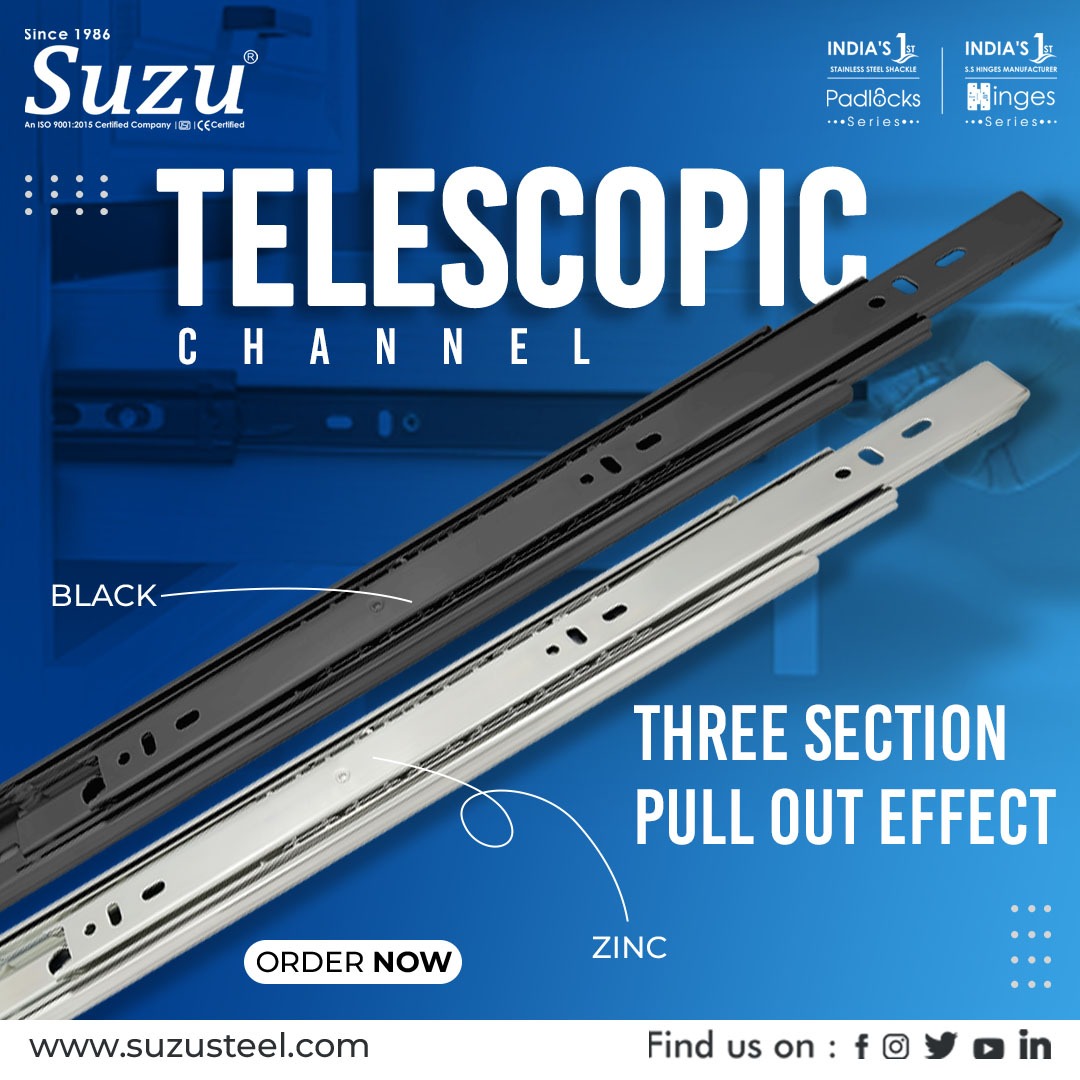
Suzu Steel Telescopic Channel: Built to Last
In today’s world, furniture is more than just design — it’s about functionality, strength, and long-term performance. And at the heart of every smooth-moving drawer lies one key component: the Telescopic Channel. At Suzu Steel, we understand how important it is to have a drawer system that runs effortlessly, holds weight with confidence, and lasts for years. That’s why our Telescopic Channel is engineered with premium stainless steel, advanced technology, and precision craftsmanship — ensuring strength in every slide. What Is a Telescopic Channel? A Telescopic Channel is a sliding mechanism that allows drawers to open and close smoothly. Unlike traditional slides, a telescopic channel is made with multiple sections (usually 2 or 3), which extend fully — giving you complete access to the drawer’s contents. It is widely used in: Kitchen drawers Office cabinets Wardrobes Industrial storage units Tool cabinets & more ⭐ Why Choose Suzu Steel Telescopic Channel? Our Telescopic Channel is not just another drawer slide — it’s a promise of performance. Here’s why it stands out: Heavy-Duty Load Capacity – Designed to carry more weight with ease. Smooth & Silent Sliding – Premium ball-bearing mechanism ensures noise-free operation. Rust-Free & Long-Lasting – Made from high-grade stainless steel for durability. Full Extension Design – Access the entire drawer without any obstruction. Easy Installation – Designed for user-friendly fitting and long-term reliability. 💼 Where Can You Use It? Whether you’re a furniture manufacturer, an interior designer, or a homeowner upgrading your space — the Suzu Steel Telescopic Channel is perfect for: Modular kitchens Office desks & drawers Wardrobe pull-outs Utility & storage cabinets Retail counters and industrial storage 🏆 The Suzu Steel Advantage Established in 1986, Suzu Steel is Asia’s first stainless steel hinge manufacturer — with decades of trust, innovation, and excellence. Our Telescopic Channel reflects the same legacy: a perfect balance of design, engineering, and strength. We believe in products that don’t just perform — they last.
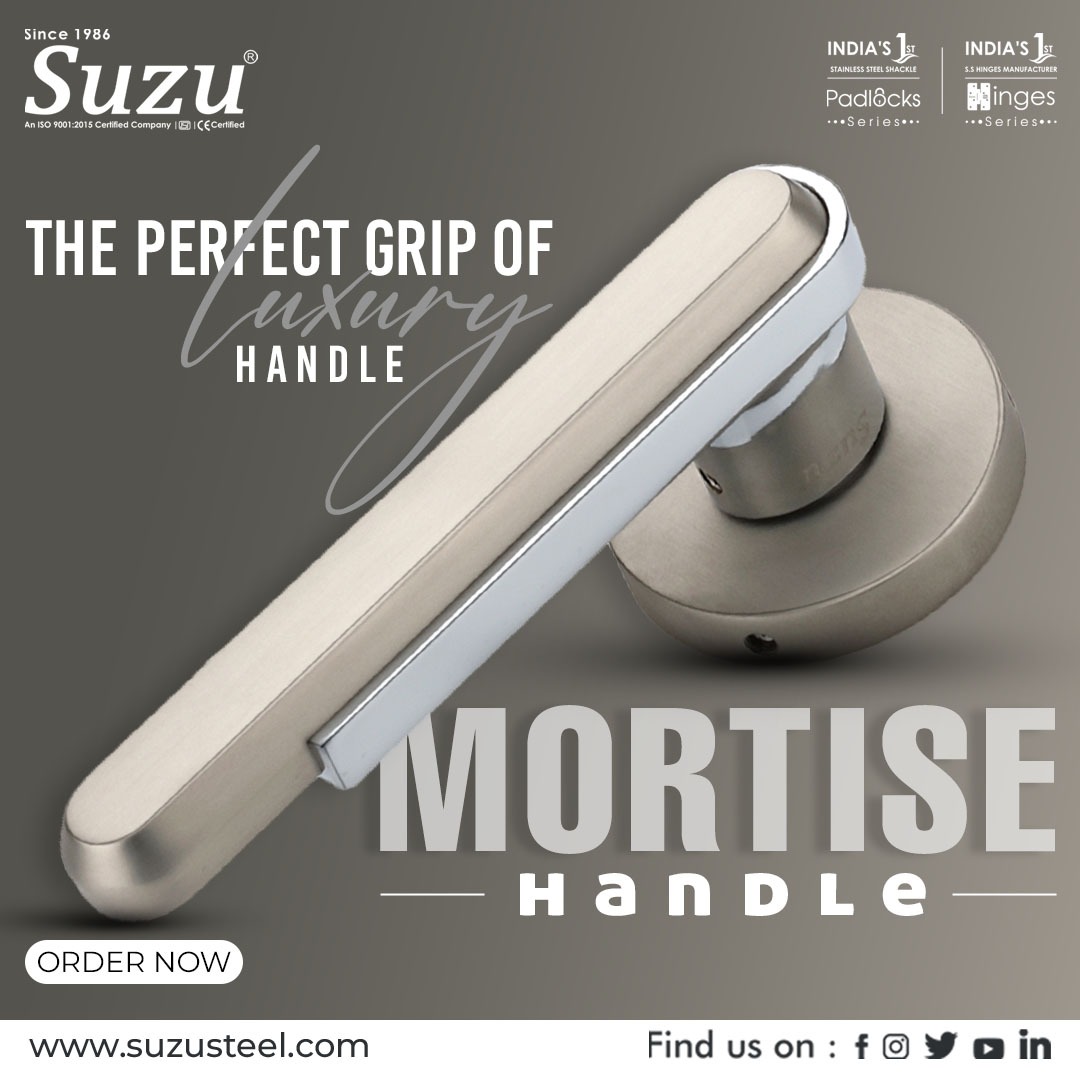
Suzu Steel Mortise Handles – Built for Elegance, Engineered for Performance
When it comes to upgrading your doors, every detail matters. From the strength of the hinges to the smoothness of the lock, every component plays a role in ensuring durability, safety, and style. Among these, Mortise Handles stand out as the perfect balance between functionality and design. At Suzu Steel, we believe that a handle isn’t just a tool to open a door – it’s a reflection of elegance, craftsmanship, and reliability. With over 39 years of excellence in the hardware industry, Suzu Steel has become a trusted name in delivering premium door hardware solutions across India. Our Mortise Handles are designed to complement modern architecture while offering the strength and longevity that Suzu Steel is known for. What Makes Suzu Steel Mortise Handles Unique? Unlike ordinary handles, Suzu Mortise Handles are engineered with precision to meet the needs of both residential and commercial spaces. Every piece is crafted from premium-grade materials to ensure maximum performance and durability. Key Features of Suzu Steel Mortise Handles: Elegant Designs – Available in contemporary and classic styles to match modern interiors. Premium Finishes – Options like SS Matt, CP, PVD Gold, Antique Brass, Black Glossy, Rose Gold, and more. Durability Guaranteed – Built from high-quality stainless steel and zamac materials. Smooth Grip & Comfort – Ergonomic design for effortless use. Corrosion Resistant – Rust-free and maintenance-free for long-term use. Versatile Applications – Perfect for homes, offices, hotels, and premium projects. Why Mortise Handles Matter in Modern Architecture A handle is often the first thing someone touches when entering a room. It leaves a lasting impression – not only through design but also through its functionality. Mortise Handles by Suzu Steel are built to elevate doors with: Strength and Security – Robust construction for complete safety. Style and Elegance – Sleek finishes that enhance interiors. Long-Term Value – 100% durable and resistant to wear & tear. With architects and builders increasingly demanding door hardware that blends durability with aesthetics, Suzu Steel Mortise Handles have become the preferred choice. Our Range of Mortise Handles Suzu Steel offers a wide collection of Mortise Handle series, designed for different preferences and interiors: Eleganza Series – Stylish models like Milano, Aura, Veneto, Roma, Pissa, and Anto. Premium Zamac Series – Bold and elegant designs like Octa and Maple. Multiple Finish Options – SS Matt, PVD Gold, Antique Brass, Black, Black Glossy, Rose Gold, and more to match your interiors. Every handle is crafted with attention to detail, ensuring both luxury and strength. Certified Excellence, Trusted Quality At Suzu Steel, quality comes first. That’s why our products carry global certifications: ISO 9001:2015 Certified – For consistent quality management.CE Approved – Meeting European standards of safety.ISI Certified – Trusted Indian standards for durability. These certifications make Suzu Mortise Handles a reliable choice for both Indian and global markets. Why Choose Suzu Steel Mortise Handles? Over 39 years of expertise in door hardware manufacturing. Asia’s first stainless steel hinge manufacturer, leading with innovation since 1986. Premium materials & modern finishes to suit every project. Trusted by architects, builders & homeowners across India. Pan-India presence with growing global reach. When you choose Suzu Steel, you’re not just investing in a product – you’re choosing strength, elegance, and performance that lasts a lifetime. Conclusion A Mortise Handle may seem like a small part of your door, but it has the power to transform the way your interiors look and feel. With Suzu Steel Mortise Handles, you get the perfect blend of aesthetic elegance and engineered strength. Built with premium materials, certified for quality, and designed to impress – they are the ultimate choice for modern homes and commercial spaces. Suzu Steel Mortise Handles – Built for Elegance, Engineered for Performance.
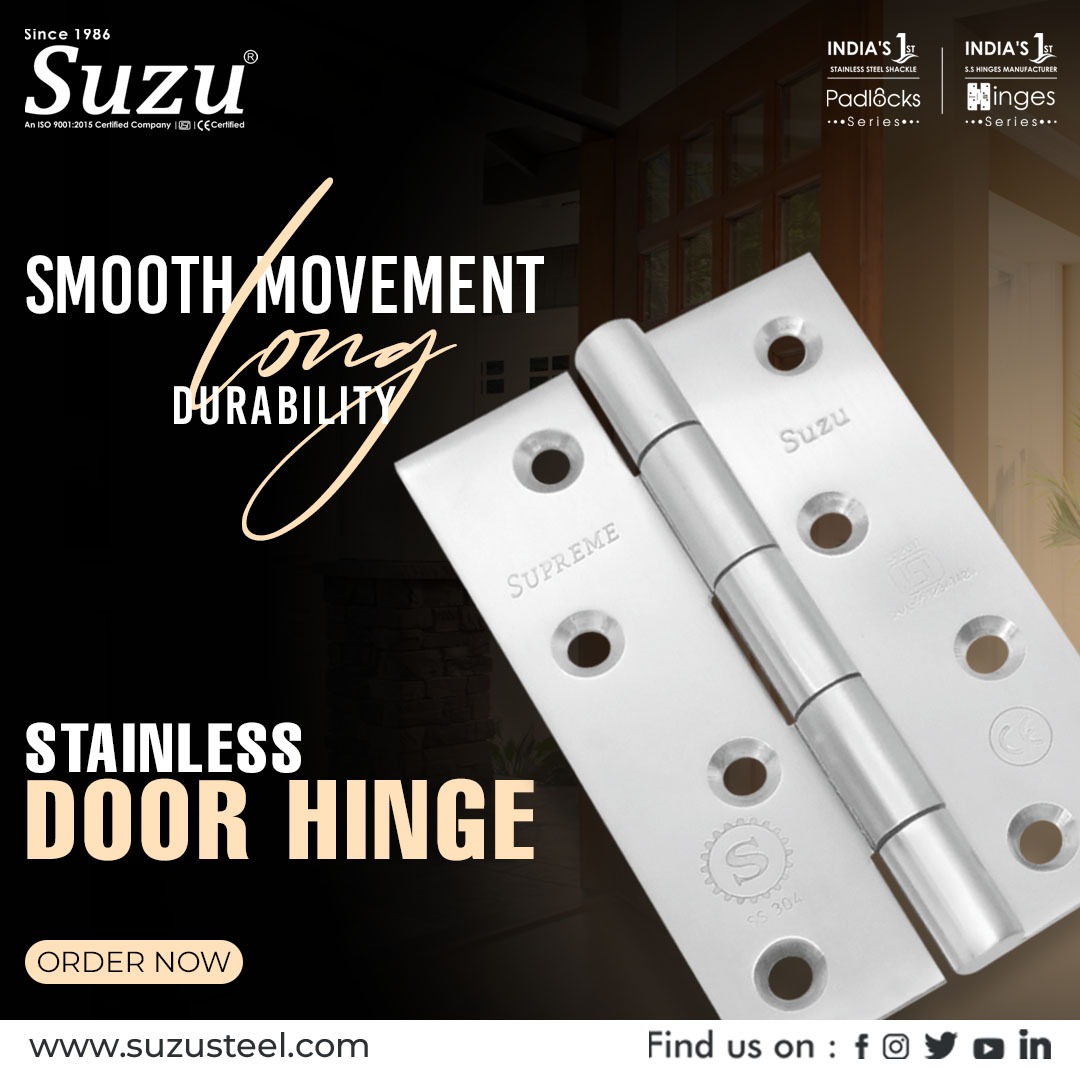
Stainless Door Hinges: Strength, Style & Long-Lasting Durability
Doors are an essential part of every home, office, and building. They provide security, privacy, and style—but behind every smooth door movement lies the hidden hero: the hinge. Among all hinge types, stainless steel door hinges stand out as the most reliable, durable, and stylish solution. For decades, stainless steel has been a symbol of strength and resilience. When used in hinges, it provides unmatched durability and protection, making it the first choice for builders, architects, and homeowners who never compromise on quality. Benefits of Using Stainless Steel Hinges for Your Doors Traditional hinges may look fine at first but tend to lose strength, squeak, or rust over time. Stainless steel hinges, however, are engineered to deliver strength, beauty, and performance for years to come. Here are some reasons why stainless steel door hinges are gaining popularity worldwide: 1. Long-Lasting Durability Stainless steel is a hard, tough, and wear-resistant material. Hinges made from it can handle heavy use daily without bending or breaking. 2. Rust & Corrosion Resistance Unlike iron or other metals, stainless steel hinges do not rust easily, even in humid or coastal regions. This makes them ideal for kitchens, bathrooms, and seaside homes. 3. Stylish Appearance Polished or matte stainless steel hinges give doors a modern, elegant, and premium finish. They not only support doors but also add to the aesthetics of interiors. 4. Smooth & Silent Operation No one likes noisy doors. With precision engineering, stainless steel hinges ensure silent, frictionless movement, enhancing the overall comfort of your space. 5. Strong Load-Bearing Capacity Be it solid wooden doors, heavy metal doors, or designer doors, stainless steel hinges are built to support weight without losing shape or efficiency. Practical Areas to Use Stainless Steel Hinges Their versatility makes them a universal choice for different applications: Residential Homes – Main doors, bedroom doors, wardrobes, kitchen cabinets Offices & Commercial Spaces – Conference rooms, cabins, entrance doors Hotels & Luxury Projects – Stylish interiors that demand both beauty & strength Industrial Use – Heavy-duty doors requiring maximum durability Suzu Steel – Leading the Innovation Since 1986 At Suzu Steel, we are proud to be Asia’s first innovator in stainless steel hinges. Since 1986, we have been setting benchmarks in door hardware solutions. With over 39 years of trust and excellence, our products have become synonymous with: Strength that lasts for generations Safety certified by ISO, CE & ISI standards Style that enhances every modern interior Silent & Smooth Performance trusted by millions Our range of hinges, mortise handles, and padlocks has been used in countless homes, offices, hotels, and large-scale projects across India and abroad. The Suzu Steel Advantage in Hinges When you choose Suzu Steel stainless door hinges, you are not just buying hardware—you are investing in peace of mind, safety, and long-lasting performance. Benefits of Choosing Suzu Steel: Premium quality stainless steel Corrosion & rust resistance for all weather conditions International certifications (ISO 9001:2015 | CE | ISI) Wide range of designs and finishes Trusted brand since 1986 Conclusion Stainless steel door hinges are more than just functional hardware – they are an investment in durability, design, and reliability. Whether it’s a simple home door or a heavy-duty commercial project, stainless hinges ensure strength, safety, and style that last a lifetime. If you want hardware that blends technology, trust, and timeless design, the choice is clear –Suzu Steel Stainless Steel Hinges – Built to Last, Built for You.
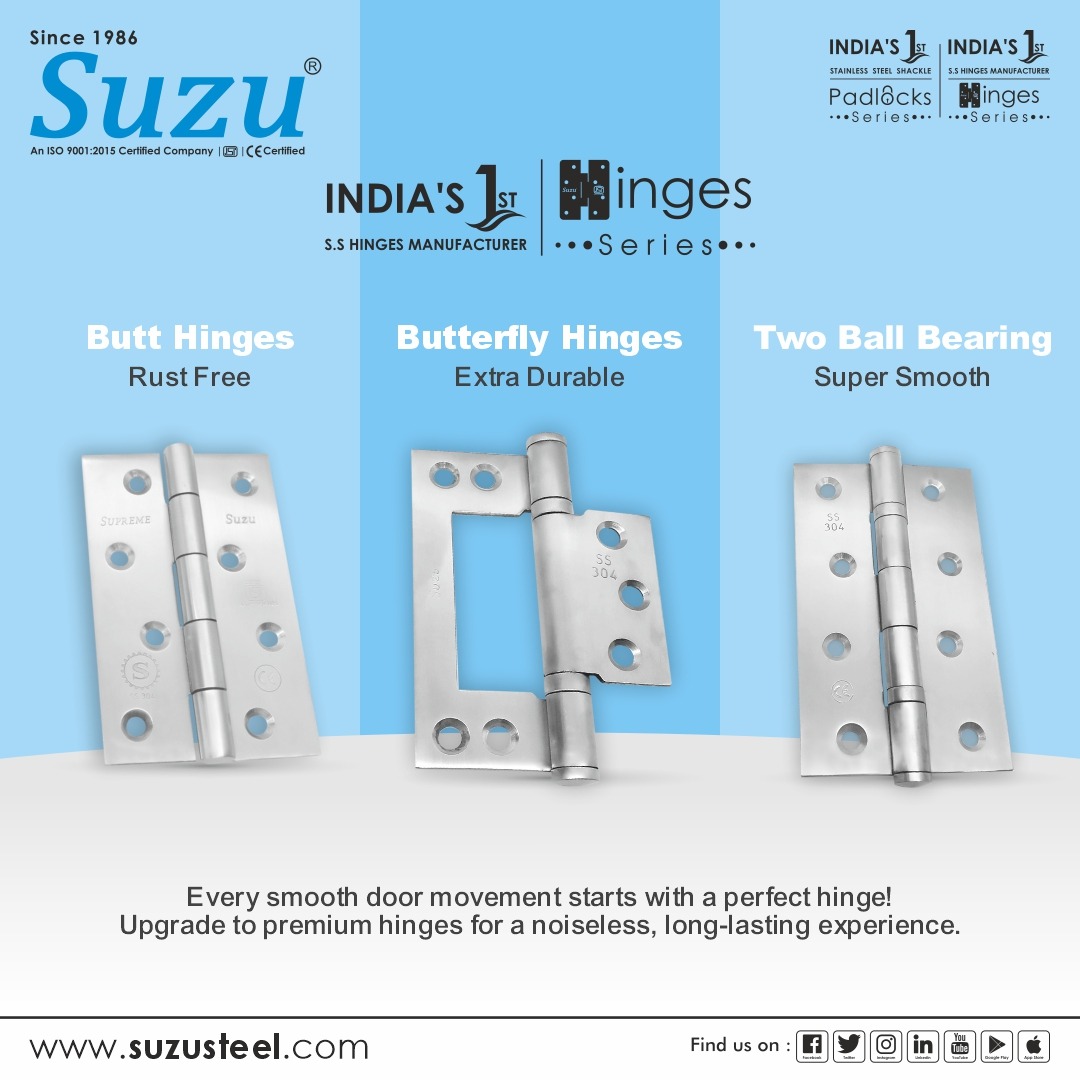
Behind Every Smooth Door Movement – A Perfect Hinge
Whenever you open or close a door, it’s the hinge that silently takes the load, ensuring smooth and effortless movement. Though small in size, a hinge is one of the most important parts of any door, cabinet, or piece of furniture. Without the right hinge, even the most beautiful door can lose its functionality, strength, and elegance. At Suzu Steel, we believe that behind every smooth door movement, there is always a perfect hinge – strong, durable, and designed to last for years. Strong Hinges, Strong Doors – Here’s Why It Matters A hinge isn’t just a connector between the door and its frame. It is: The strength behind every door – carrying the weight without bending. The reason for smooth operation – ensuring doors open and close silently. The safeguard of safety – keeping doors aligned and secure. A style enhancer – maintaining a premium and modern finish. This is why choosing the right hinge is critical – it defines both performance and longevity. Types of Hinges for Modern Needs Different applications demand different hinges. Some of the most popular ones include: Butt Hinges – For heavy wooden doors in homes and offices. Concealed Hinges – Perfect for modular kitchens, wardrobes, and cabinets. Hydraulic Hinges – Known for silent, soft-closing action. Stainless Steel Hinges – Durable, rust-proof, and ideal for long-term use. The Smart Choice for Modern Doors – Stainless Steel Hinges Among all materials, stainless steel stands out because of its:Corrosion Resistance – Withstands humidity and weather conditions.Strength & Load Capacity – Handles heavy-duty applications.Low Maintenance – Long-lasting shine and performance.Premium Look – Complements modern interiors and architecture. This is why Suzu Steel’s Stainless Steel Hinges are trusted across India and beyond. Your Trusted Source for Stainless Steel Hinges in Rohtak If you are based in Rohtak and searching for high-quality hardware, Suzu Steel is your trusted partner. With a strong distribution network, we provide premium Stainless Steel Hinges in Rohtak that are widely used in: Homes & Residential Apartments Offices & Commercial Spaces Educational Institutions Hospitals & Government Projects Our hinges are ISO-certified, tested for durability, and designed to provide smooth, silent, and long-lasting performance. The Suzu Steel Advantage For more than 39 years, Suzu Steel has been the pioneer of stainless steel hardware in India. Our hinges are: Made from premium-grade stainless steel Used in 500+ cities across India Trusted by builders, architects, and homeowners Backed by innovation and world-class manufacturing When it comes to Stainless Steel Hinges in Rohtak, we ensure our customers get the perfect combination of strength, safety, and style. Conclusion Behind every smooth door movement is not luck – it’s the perfect hinge that works silently in the background. If you are looking for the best Stainless Steel Hinge in Rohtak, Suzu Steel offers the durability, reliability, and elegance you need. Strong doors begin with strong hinges – and with Suzu Steel, you can trust strength that lasts for generations.